
A query's journey
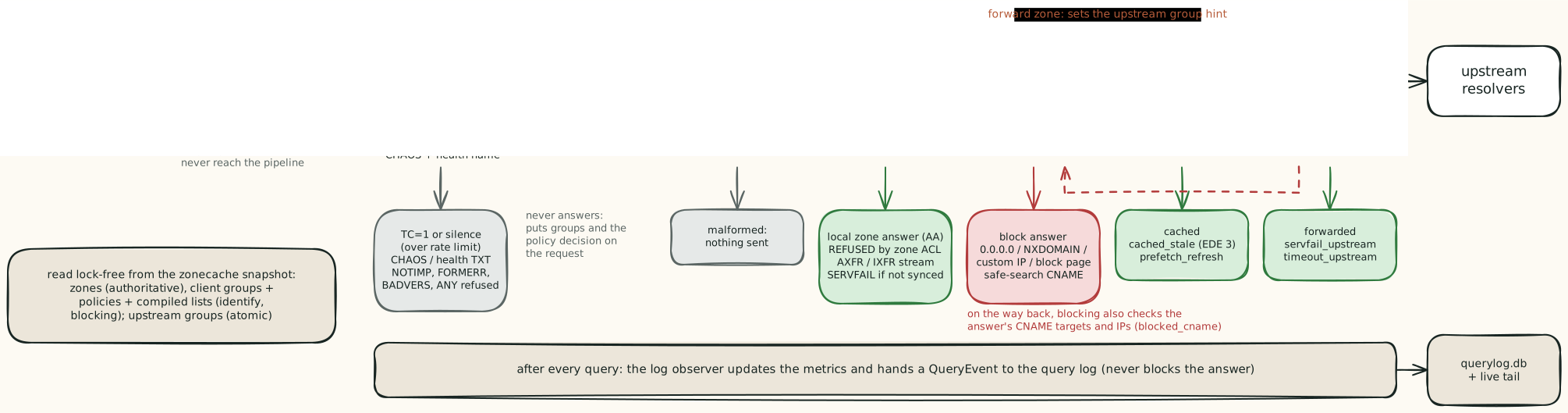
Every DNS query, on every transport, goes through the same fixed chain of seven stages. A stage either answers (and the query goes no further), or calls the next stage and may look at the answer on the way back. When the chain returns, an observer records the outcome. This page walks that path.
Code: internal/dnsserver (transports), internal/pipeline (the chain and
the status taxonomy), internal/stages/* (one package per stage), and the
wiring in cmd/kudurru/serve.go.
Before the pipeline: transports
| Transport | Implementation | PROXYv2 | TSIG |
|---|---|---|---|
| Do53 UDP | miekg/dns, one SO_REUSEPORT socket per CPU | yes | yes |
| Do53 TCP | miekg/dns, one socket per CPU | yes | yes |
| DoT | miekg/dns tcp-tls, ALPN dot | yes | yes |
| DoH (HTTP/1.1, HTTP/2) | net/http, GET ?dns= or POST | no | no |
| DoQ | quic-go, ALPN doq | no | no |
| DoH3 | quic-go HTTP/3 | no | no |
Every transport ends in one handler that stamps Received and a 5 s
deadline, runs the chain and writes the reply. DoH, DoQ and DoH3 give the
pipeline a fresh message ID, because their clients send ID 0.
Who is the client? (PROXYv2)
When dnsdist fronts kudurru, the real client address arrives in a PROXYv2 header. kudurru trusts that header only from known peers, because the client address decides policies, ACLs and the query log.
flowchart TD
    P(["UDP datagram or TCP/DoT connection"]) --> SIG{"starts with the<br/>PROXYv2 signature?"}
    SIG -- "no" --> PEER["client = transport peer"]
    SIG -- "yes" --> LIST{"peer listed in<br/>listeners.proxyProtocolFrom?<br/>(hosts, or CIDRs when<br/>a secret is set)"}
    LIST -- "no" --> DROP1["drop<br/>proxy_untrusted_peer"]
    LIST -- "yes" --> SEC{"secret file<br/>configured?"}
    SEC -- "yes" --> TLV{"TLV 0xE0 equals<br/>the secret?"}
    TLV -- "no" --> DROP2["drop<br/>proxy_unauthenticated"]
    TLV -- "yes" --> CMD
    SEC -- "no (only 127.0.0.1<br/>and ::1 may be listed)" --> CMD{"PROXY command"}
    CMD -- "PROXY, INET/INET6" --> HDR["client = address in the header<br/>ProxiedFrom = dnsdist"]
    CMD -- "LOCAL / AF_UNSPEC" --> PEER
Drops never reach the pipeline; they are counted in
kudurru_dns_dropped_total{reason}. A bad TSIG signature is answered with
NOTAUTH by the transport, also before the pipeline.
The stages
| # | Stage | Question it answers | Can answer with | Status values |
|---|---|---|---|---|
| 1 | ingress | Is this query sane, and is the client within its rate? | TC=1 or silence over the UDP rate limit; NOTIMP for any opcode but QUERY; FORMERR; BADVERS; REFUSED for ANY; CHAOS id.server/version.bind; the health.kudurru.internal. TXT | blocked_rate_limit, dropped, refused_acl, special_domain |
| 2 | identify | Which client groups, which policy? | never answers; attaches Client.GroupIDs and the policy decision | none |
| 3 | control | Is the message malformed? | nothing (a drop) | dropped |
| 4 | authoritative | Is the name in a local zone? | the zone's answer (AA), REFUSED by the zone ACL, an AXFR/IXFR stream, SERVFAIL while unsynced; for a forward zone it sets the upstream group and passes on | authoritative, refused_acl, servfail_unsynced |
| 5 | blocking | Is the name blocked for this client? | a block answer, a safe-search CNAME; after the next stages return, it checks CNAME targets and IPs in the answer | blocked_list, blocked_exact, blocked_regex, blocked_cname, blocked_safesearch |
| 6 | cache | Is the answer already known? | a cached, stale or prefetching answer | cached, cached_stale, prefetch_refresh |
| 7 | upstream | Who knows the answer? | always answers (it is the last stage) | forwarded, servfail_upstream, timeout_upstream |
The order puts the cheap and the certain first. Authoritative answers come before blocking, so your own zones are never blocked. Blocking comes before the cache, so a block is never cached and one cached answer can serve every client; blocking also wraps the cache, so cached answers are still inspected on the way out.
The whole decision as one flowchart
flowchart TD
    Q(["query"]) --> RL{"UDP and over<br/>the rate limit?"}
    RL -- "yes" --> SLIP["50 %: empty TC=1 answer<br/>50 %: silence"]
    RL -- "no" --> SAN{"opcode QUERY, one question,<br/>EDNS version 0, not ANY?"}
    SAN -- "no" --> ERR["NOTIMP / FORMERR /<br/>BADVERS / REFUSED"]
    SAN -- "yes" --> SPEC{"CHAOS or<br/>health.kudurru.internal.?"}
    SPEC -- "yes" --> SPA["answer directly<br/>special_domain"]
    SPEC -- "no" --> ID["identify: groups + policy"]
    ID --> CTL{"malformed?"}
    CTL -- "yes" --> NONE["send nothing<br/>dropped"]
    CTL -- "no" --> ZONE{"longest matching zone"}
    ZONE -- "primary zone" --> ACL{"queryAccess<br/>allows client?"}
    ACL -- "no" --> REF["REFUSED"]
    ACL -- "yes" --> SYNC{"snapshot synced<br/>(and fresh)?"}
    SYNC -- "no" --> SF["SERVFAIL, never NXDOMAIN<br/>servfail_unsynced"]
    SYNC -- "yes" --> AUTH["answer from the zone<br/>authoritative"]
    ZONE -- "forward zone<br/>(the root '.' is one)" --> HINT["set the upstream group hint"]
    HINT --> BLK{"blocked for<br/>this client?"}
    BLK -- "yes" --> BA["block answer<br/>blocked_*"]
    BLK -- "no" --> C{"in the cache?"}
    C -- "fresh" --> CA["cached"]
    C -- "stale" --> ST["refresh or<br/>cached_stale"]
    C -- "miss" --> UP["upstream group"]
    UP --> INS{"answer's CNAMEs or<br/>IPs blocked?"}
    CA --> INS
    ST --> INS
    INS -- "yes" --> BC["block answer<br/>blocked_cname"]
    INS -- "no" --> OK["answer<br/>forwarded / cached / ..."]
The bootstrap creates a root forward zone . pointing at the default
upstream group, so in practice every name matches some zone: names in
primary zones are answered locally, everything else takes the forward branch.
Three journeys
A name on the internet, first time and second time
sequenceDiagram
    autonumber
    participant C as client
    participant P as ingress → identify → control
    participant A as authoritative
    participant B as blocking
    participant K as cache
    participant U as upstream
    participant R as 1.1.1.1
    C->>P: A example.org
    P->>A: request (+ groups, policy)
    A->>B: zone "." is forward → hint "default"
    B->>B: lists: no match
    B->>K: next
    K->>U: miss → one shared fetch
    U->>R: query (fresh ID, RD, ECS stripped)
    R-->>U: A 93.184.215.14, TTL 300
    U-->>K: forwarded, cacheable
    K->>K: store (TTL clamped 5 s..24 h)
    K-->>B: answer
    B->>B: inspect answer: IP not on a list
    B-->>C: answer (status forwarded)
    Note over C,K: the same query a minute later stops at the cache
    C->>K: A example.org
    K-->>B: TTL counted down, status cached
    B-->>C: answer
A blocked name
sequenceDiagram
    autonumber
    participant C as client 10.0.20.15
    participant I as identify
    participant A as authoritative
    participant B as blocking
    participant L as query log
    C->>I: A ads.example
    I->>I: group kids → Policy kids (lists ads, adult)
    I->>A: request + decision
    A->>B: forward zone "." → next
    B->>B: list dns/ads matches ||ads.example^<br/>no @@ exception in that list
    B-->>C: A 0.0.0.0, TTL 10 m, EDE 15 "dns/ads"
    Note over B,L: never reaches the cache or the upstream
    B--)L: status blocked_list, list dns/ads, rule ||ads.example^
A local name that points outside
sequenceDiagram
    autonumber
    participant C as client
    participant A as authoritative
    participant Z as zone home.example.com.
    participant N as blocking → cache → upstream
    C->>A: A www.home.example.com
    A->>Z: lookup (longest suffix)
    Z-->>A: CNAME shop.example.net. (leaves the zone)
    A->>A: target in another local primary zone? no
    A->>N: RD set → sub-request for shop.example.net.
    N-->>A: A 203.0.113.7 (status forwarded)
    A-->>C: CNAME + A, AA cleared,<br/>status and upstream from the inner answer
A CNAME chase follows other local primary zones first, stops at 20 hops (SERVFAIL on a loop), and returns only the partial chain when the client did not set RD or the target zone refuses the client.
Answer, error, or silence
What the client receives depends on the transport when a stage decides to send nothing:
| Outcome | UDP | TCP / DoT | DoH / DoH3 | DoQ |
|---|---|---|---|---|
| an answer | datagram, truncated to the EDNS size | message | HTTP 200, Cache-Control: max-age=<min TTL> | stream |
a drop (ErrDrop, rate limit) | nothing | connection closed | stream reset | DOQ_REQUEST_CANCELLED |
| a pipeline error | SERVFAIL | SERVFAIL | SERVFAIL | SERVFAIL |
| an unparsable message | miekg rejects it | miekg rejects it | HTTP 400/413/414/415 | DOQ_PROTOCOL_ERROR |
Status values
Statuses below 16 mean the query was answered normally; 16 to 23 mean it
was blocked; 24 and above mean an error. The query log, the
kudurru_dns_responses_total{status} metric and the dashboard colours all
use this list (internal/pipeline/status.go).
| Class | Values produced today | Reserved, not produced yet |
|---|---|---|
| answered | forwarded, cached, cached_stale, authoritative, prefetch_refresh, special_domain | local_record, retried, in_progress |
| blocked | blocked_list, blocked_regex, blocked_exact, blocked_cname, blocked_safesearch, blocked_rate_limit | blocked_upstream, blocked_rpz |
| error | refused_acl, dropped, servfail_upstream, timeout_upstream, servfail_unsynced | dnssec_bogus |
What the stages read
No stage takes a lock or touches the store on the query path. Each one reads an immutable value that something else swaps atomically:
| Value | Read by | Replaced by |
|---|---|---|
| zonecache snapshot: zones, the policy index, compiled lists | authoritative, identify, blocking | the zonecache rebuild after a store event or a list change (configuration) |
| upstream groups | upstream, cache (ECS subnet) | a reload of upstreams.* |
| cache settings | cache | a reload of cache.* |
| blocking defaults, the blocking toggle | blocking | a reload of blocking.*; POST /api/v1/dns/blocking |
| rate limits | ingress | a reload of ratelimit.* |
| safe-search catalogue | blocking | the catalogue refresher |
| query log privacy | query log collector | a reload of querylog.* |
After the chain: the observer
When the chain returns, the log observer runs synchronously but never waits:
it updates the DNS metrics and makes a non-blocking hand-off of a
QueryEvent to the query log. The health name and the dashboard's built-in
dig are not logged. Observability follows the event from
there.
Not built yet
local (custom host records, .local/.onion/RFC 6303 answers), rewrite
(DNS rewrites, views, DNS64), dnssec (validation) and postprocess
(rebinding protection) are planned stages whose names are reserved in
pipeline.Order; no package implements them. NSID is not implemented, and
the epoch in the health TXT is always 0. The control stage has no
configuration keys yet, so it only drops malformed queries.