
Upstreams and the response cache
kudurru is a forwarding resolver. It does not walk the DNS tree itself: a name that no local zone answers goes to an upstream group, and the response cache sits in front of the groups so that most queries never leave the node. This page follows a forwarded query from the moment the pipeline decides it is not authoritative.
Code: internal/upstream (groups, strategies, health, ECS),
internal/cache (the sharded LRU), internal/stages/cache and
internal/stages/upstream (the DNS rules on top), cmd/kudurru/reload.go
(hot reload).
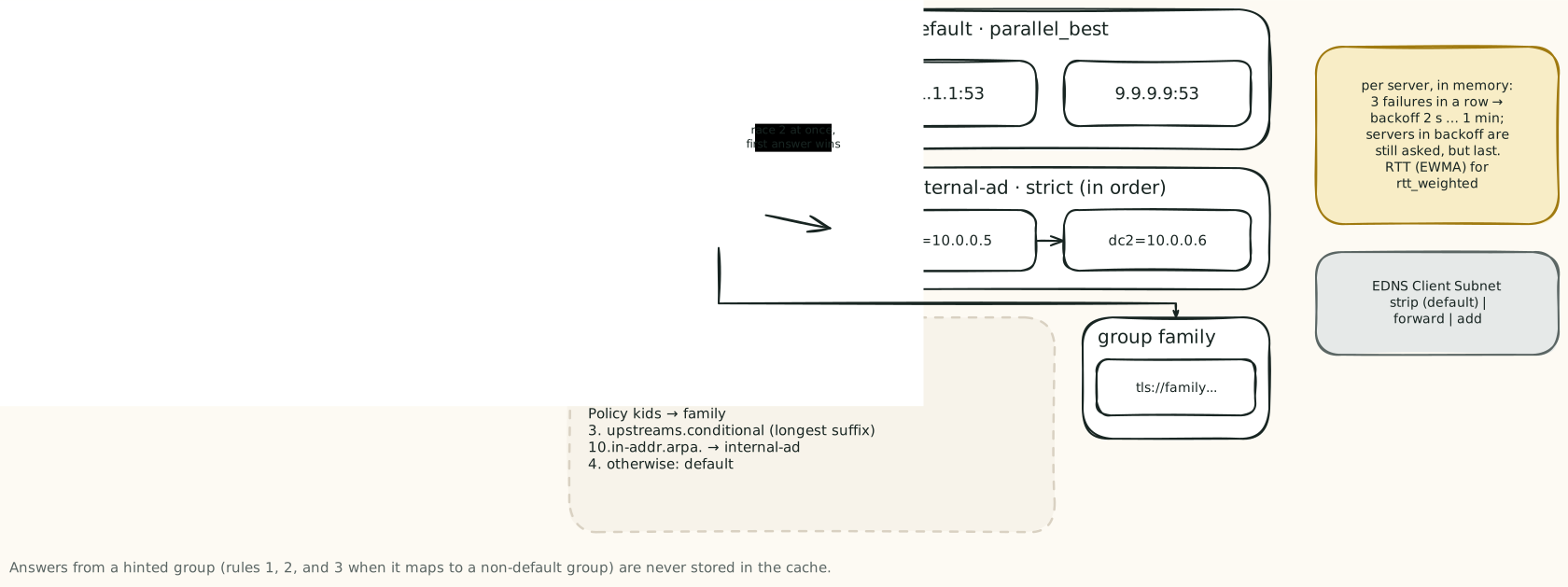
Which group answers
Three places can name a group, and they are checked in a fixed order. The
authoritative stage sets a hint for a forward zone, the blocking stage can
replace it with the client's Policy, and the upstream stage turns the hint
(or the absence of one) into a group with Set.Route.
flowchart TD
    Q(["forwarded query<br/>qname, Request.UpstreamGroup"]) --> FZ{"longest matching zone<br/>is a forward zone?"}
    FZ -- "yes" --> FG["hint = zone.spec.forward.upstreamGroup<br/>(default: default)"]
    FZ -- "no" --> NOH["hint = empty"]
    FG --> POL
    NOH --> POL{"client Policy sets<br/>upstreamGroup, and hint<br/>is empty or default?"}
    POL -- "yes" --> PG["hint = Policy.upstreamGroup"]
    POL -- "no" --> R
    PG --> R{"hint set and<br/>not default?"}
    R -- "yes" --> KNOWN{"group exists?"}
    KNOWN -- "yes" --> USE["use the hinted group<br/>answer not cacheable"]
    KNOWN -- "no" --> SF["SERVFAIL, EDE 23<br/>never falls back to public resolvers"]
    R -- "no" --> COND{"longest suffix in<br/>upstreams.conditional?"}
    COND -- "maps to a group" --> CG["use that group<br/>answer not cacheable"]
    COND -- "maps to default<br/>(dnsmasq # exception)" --> DEF
    COND -- "no match" --> DEF["use the default group<br/>answer cacheable"]
The precedence, from strongest to weakest:
- A forward zone's own group, when it is not
default. - The client's
Policy.upstreamGroup(the highest-priority Policy that sets one). - The longest suffix in
upstreams.conditional. - The
defaultgroup, which must exist.
The bootstrap root zone . is a forward zone to default, so on a fresh
install every name that no other zone claims takes the default path and
still consults the conditional map. A Policy beats that root zone, but not a
forward zone with a group of its own.
Inside a group
upstreams:
  groups:
    default:     { servers: ["1.1.1.1:53", "9.9.9.9:53"], strategy: parallel_best, timeout: 2s }
    internal-ad: { servers: ["dc1=10.0.0.5:53", "dc2=10.0.0.6:53"], strategy: strict }
  bootstrap: ["1.1.1.1:53"]          # plain IP resolvers for upstream host names
  conditional: { "corp.example.": internal-ad, "[/10.in-addr.arpa/]": internal-ad }
  ecs: { mode: strip }               # strip | forward | add
A server is a dnsproxy address with an optional name= prefix. The scheme
picks the transport: bare ip:port or udp:// (UDP, TCP on truncation),
tcp://, tls:// (DoT), https:// (DoH), h3:// (DoH3), quic:// (DoQ)
and sdns:// (DNSCrypt or a DoH stamp). The query log and the metrics name
a server <group>/<name or address>.
Strategies
Every strategy first splits the servers into healthy ones and ones in backoff. Servers in backoff always go last, earliest recovery first, so a group never fails without asking every server. The strategy then cuts the order into batches: a batch of two or more is raced and the first usable answer wins; batches run one after the other until one succeeds.
flowchart LR
    subgraph parallel_best["parallel_best (default)"]
        direction LR
        pb1["race 2 random<br/>healthy servers"] -- "both fail" --> pb2["race all<br/>the others"]
    end
    subgraph strict
        direction LR
        s1["server 1<br/>(config order)"] -- "fails" --> s2["server 2"] -- "fails" --> s3["..."]
    end
    subgraph random
        direction LR
        r1["random server"] -- "fails" --> r2["next random"] -- "fails" --> r3["..."]
    end
    subgraph rtt_weighted["rtt_weighted"]
        direction LR
        w1["pick by 1/RTT<br/>(weighted random)"] -- "fails" --> w2["fastest of the rest"] -- "fails" --> w3["..."]
    end
There is no retry beyond this failover, with one exception: a DoT server that answers REFUSED is asked once more on a fresh connection.
sequenceDiagram
    autonumber
    participant St as upstream stage
    participant G as group "default" (parallel_best)
    participant A as 1.1.1.1
    participant B as 9.9.9.9
    St->>G: Exchange(query), timeout 2s per server
    par race the first batch
        G->>A: query
    and
        G->>B: query
    end
    B-->>G: NOERROR (first usable answer)
    G--)A: cancel (the loser is not counted against its health)
    G-->>St: answer, Upstream = "default/9.9.9.9:53"
Server health
Health is per server and lives in memory. Timeouts, network errors and
REFUSED count as failures. A SERVFAIL is not usable, but it proves that the
server is alive, so it resets the failure count instead. RTT is an EWMA
(α = 0.3) that rtt_weighted uses. The thresholds have no configuration
keys.
stateDiagram-v2
    direction LR
    [*] --> Healthy
    Healthy --> Healthy: answer or SERVFAIL (failures = 0)
    Healthy --> Healthy: failure 1 or 2
    Healthy --> Backoff: 3rd consecutive failure
    Backoff --> Probing: backoff expires (2 s, doubling to 1 min)
    Probing --> Healthy: one usable answer
    Probing --> Backoff: probe fails (backoff doubles)
    note right of Backoff
        still asked, but last,
        after every healthy server
    end note
kudurru_upstream_healthy{upstream} follows this state, and the
Upstreams page of the dashboard shows it next to the traffic each server
carried (GET /api/v1/stats/upstreams).
What goes upstream
kudurru builds its own query: a fresh ID, RD set, the client's DO and CD
bits, an EDNS buffer of 1232 bytes, the first question only. No other client
EDNS option is forwarded. EDNS Client Subnet follows upstreams.ecs.mode:
| Mode | What the upstream sees |
|---|---|
strip (default) | no ECS at all |
forward | the client's own ECS option, shortened to at most /24 (IPv4) or /56 (IPv6) |
add | as forward; when the client sent none, a prefix of the client's address, for public unicast addresses only |
The response cache
The cache stores packed answers in a sharded LRU (up to 256 shards, each with
its own lock). The key is (qname, qtype, qclass, DO, CD, ECS subnet sent upstream). Client identity and Policy are not in the key: blocking runs
before the cache on the way in and inspects the answer again on the way out,
so one cached answer can serve every client safely.
What the cache stage does with a query
flowchart TD
    IN(["query reaches the cache stage"]) --> BY{"bypass?<br/>cache disabled, a hinted group,<br/>or ANY/AXFR/IXFR/non-IN"}
    BY -- "yes" --> UP["upstream stage<br/>(nothing stored)"]
    BY -- "no" --> GET{"lookup"}
    GET -- "fresh hit" --> HOT{"hot and close<br/>to expiry?"}
    HOT -- "no" --> CACHED["answer from cache<br/>status cached"]
    HOT -- "yes" --> PF["answer from cache<br/>status prefetch_refresh<br/>+ background refresh"]
    GET -- "stale hit" --> HOLD{"a refresh failed in<br/>the last 30 s?"}
    HOLD -- "yes" --> STALE["serve stale now<br/>TTL 30 s, EDE 3<br/>status cached_stale"]
    HOLD -- "no" --> WAIT{"refresh (coalesced),<br/>wait at most 1.8 s"}
    WAIT -- "fresh answer in time" --> FWD["fresh answer<br/>status forwarded"]
    WAIT -- "fails or too slow" --> STALE
    GET -- "miss" --> FETCH["fetch (coalesced)<br/>and wait"]
    FETCH --> STORE{"cacheable?"}
    STORE -- "yes" --> SAVE["store, then answer<br/>status forwarded"]
    STORE -- "no" --> PASS["answer only"]
Identical misses share one fetch (singleflight on the key). The fetch runs detached from the client with its own 5 s limit, so a client that gives up does not cancel the refresh that the next client needs.
The life of an entry
stateDiagram-v2
    direction LR
    [*] --> Fresh: upstream answer stored<br/>TTL clamped to minTTL..maxTTL
    Fresh --> Fresh: hit
    Fresh --> Prefetching: 5 hits within 2 h and<br/>less than max(1 s, TTL/10) left
    Prefetching --> Fresh: background refresh stored
    Fresh --> Stale: TTL reaches 0
    Stale --> Fresh: refresh succeeds
    Stale --> Held: refresh fails
    Held --> Stale: 30 s later
    Stale --> [*]: 72 h after expiry<br/>(sweep every minute)
Fresh --> [*]: LRU eviction or flush| Setting | Default | Effect |
|---|---|---|
cache.maxEntries | 200000 | 0 turns the stage off (and flushes it) |
cache.minTTL / maxTTL | 5s / 24h | clamp on every stored TTL |
cache.negativeTTL | 5m | cap for NXDOMAIN and NODATA, which use the SOA minimum |
cache.prefetch.threshold / window | 5 / 2h | hits needed inside the window; 0 turns prefetch off |
cache.serveStale.ttl | 72h | how long an expired entry is kept; 0 turns serve-stale off |
cache.serveStale.answerTTL | 30s | TTL of a stale answer, and the hold after a failed refresh |
cache.serveStale.maxWait | 1800ms | how long a stale hit waits for a refresh |
Never cached
- Answers from local zones: the authoritative stage answers before the cache.
- Blocked and safe-search answers: the blocking stage answers before the cache.
- Queries routed to a hinted group (a forward zone with its own group, or a
Policy group), and conditional routes to a group other than
default. - SERVFAIL, REFUSED and other error rcodes, truncated answers and TTL 0.
- ANY, AXFR, IXFR, non-IN classes and multi-question queries.
Persistence and flushing
sequenceDiagram
    participant S as kudurru serve
    participant C as cache
    participant L as local.db (blob cache.dump)
    S->>L: on start, before listeners serve
    L-->>C: restore entries (dump younger than 24 h, skip entries past stale)
    loop every 10 minutes
        C->>L: save, least recently used first per shard
    end
    S->>C: shutdown
    C->>L: final save (5 s limit)
The cache is per node and so is a flush. POST /api/v1/cache/flush empties
the whole cache, or one name across the common query types. Deleting a zone
flushes its apex, approving an unblock request flushes the name, and any
change under upstreams.* flushes everything, because a cached answer may
have come from a server that is no longer configured.
When the answer is an error
| Situation | Client gets | Status | EDE |
|---|---|---|---|
| hinted group does not exist | SERVFAIL | servfail_upstream | 23 Network Error |
| every server failed, at least one sent SERVFAIL or REFUSED | that message, rcode SERVFAIL | servfail_upstream (timeout_upstream if every error was a timeout) | the upstream's own |
| every server failed, none answered | SERVFAIL | timeout_upstream / servfail_upstream | 22 No Reachable Authority / 23 Network Error |
| stale entry, refresh failed or slow | the stale answer, TTL 30 s | cached_stale | 3 Stale Answer |
EDE options appear only when the client sent EDNS. A failure on a miss reaches the client as SERVFAIL; a failure on a stale hit yields the stale answer and holds the entry for 30 s, so a dead upstream is not asked again on every query.
Hot reload
Every key under upstreams.* reloads without a restart. The reloader builds
a new set of groups, swaps it in atomically, retires the old set after 30 s
(in-flight queries finish on it) and flushes the cache. Cache settings
reload in place; new limits apply to entries stored from then on.
Metrics
| Metric | Meaning |
|---|---|
kudurru_upstream_healthy{upstream} | 1 healthy, 0 in backoff |
kudurru_upstream_requests_total{upstream,proto} | every exchange, race losers included |
kudurru_upstream_responses_total{upstream,rcode} | every response |
kudurru_upstream_errors_total{upstream,error} | timeout, network, refused, servfail |
kudurru_upstream_request_duration_seconds{upstream} | exchanges that returned a response |
kudurru_upstream_inflight{upstream} | exchanges in progress |
kudurru_cache_entries{kind} | positive and negative entries, stale ones included |
kudurru_cache_requests_total, kudurru_cache_hits_total{kind,stale} | lookups and hits; bypassed queries are not counted |
kudurru_cache_evictions_total{reason} | capacity, expired, flush |
kudurru_cache_prefetches_total | background refreshes |
Next: Zones and transfers covers the queries that never reach this page because kudurru is the authority.